
Introduction
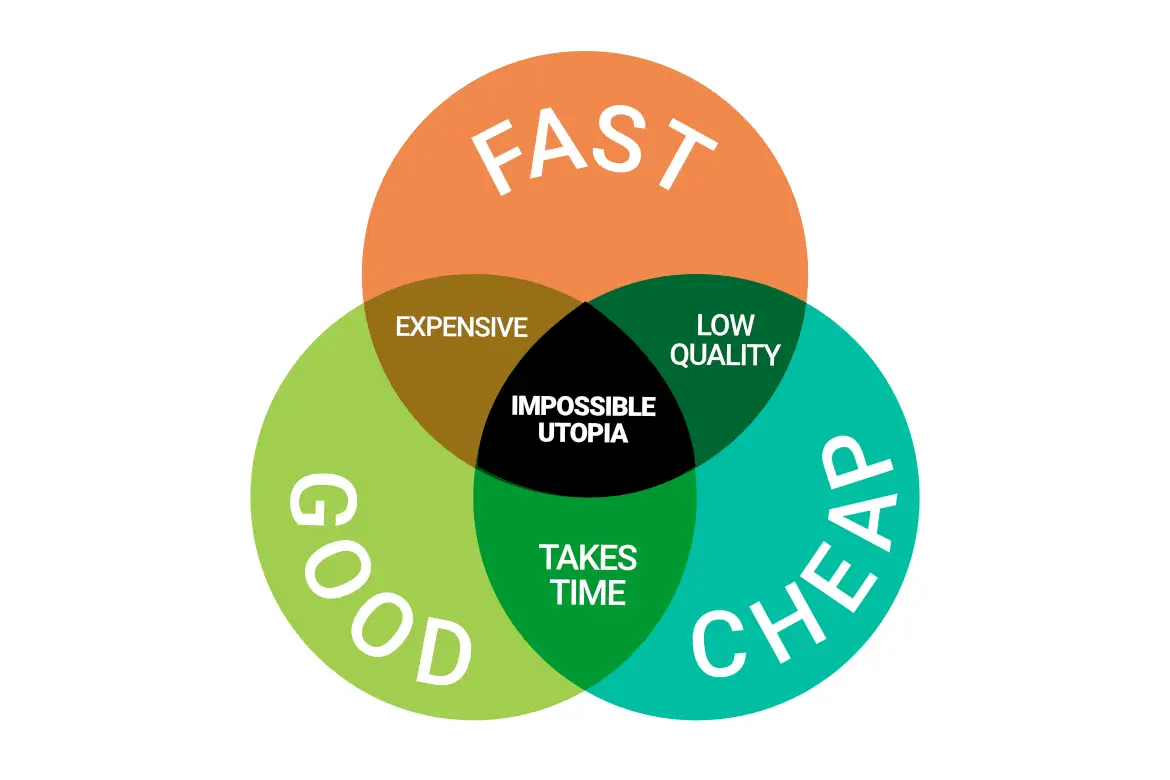
The “Fast, Cheap, and Good” principle is often mentioned in creative and technical projects, particularly in web development, design, engineering and audiovisual production. It is based on the idea that it is very difficult, if not impossible, to complete a project that perfectly satisfies all three criteria at the same time. Here is a detailed explanation of this principle.
The 3 criteria
Fast
This criterion concerns the speed of project delivery. A “fast” project is delivered within a very short timeframe, often because of tight deadlines or the need to respond quickly to a market opportunity.
Cheap
A “cheap” project is carried out with a limited budget. This means reducing costs for human resources, materials, tools and other project-related expenses. The goal is to minimize spending while still achieving the essential objectives.
Good
Quality refers to the value and excellence of the final work. A quality project is one that meets or exceeds expectations in terms of performance, durability, aesthetics and customer satisfaction.
The rule of two
The “Fast, Cheap, and Good” principle is based on the idea that you can only choose two of the three criteria at the same time. Here are the possible combinations:
Fast and Cheap
If you choose to complete a project quickly and at a low cost, quality may suffer. Limited resources and a short timeframe can lead to compromises in the finish, durability or performance of the final product.
Example: Developing a website in a few days with a reduced budget, but with basic features and design.
Fast and Good
A fast and high-quality project will require a significant financial investment. To achieve high quality within a short deadline, additional resources must be mobilized, such as experienced professionals, advanced technologies or paid overtime.
Example: Launching an advertising campaign in one week with highly skilled designers and marketers, but with a high budget.
Cheap and Good
Completing a project at a lower cost while maintaining high quality takes more time. The process often involves optimizing resources, searching for cost-effective solutions and carrying out multiple revisions.
Example: Developing a mobile application with a limited budget, while taking several months to ensure that all features and tests are properly completed.
Why is it important?
Understanding the “Fast, Cheap, and Good” principle is crucial for managing expectations and making decisions in a project. It helps to:
Set priorities
Knowing what matters most to the client or the team — time, budget or quality — makes it easier to direct efforts and resources.
Manage resources
Optimize the use of available resources according to the priorities that have been defined.
Communicate effectively
Provide a clear basis for discussions with clients and stakeholders about the trade-offs that may be necessary.
Conclusion
The “Fast, Cheap, and Good” principle is a useful framework for understanding the limitations and challenges of projects. By accepting that it is difficult to have everything at once, teams can better plan, execute and deliver projects that meet expectations while respecting unavoidable constraints.